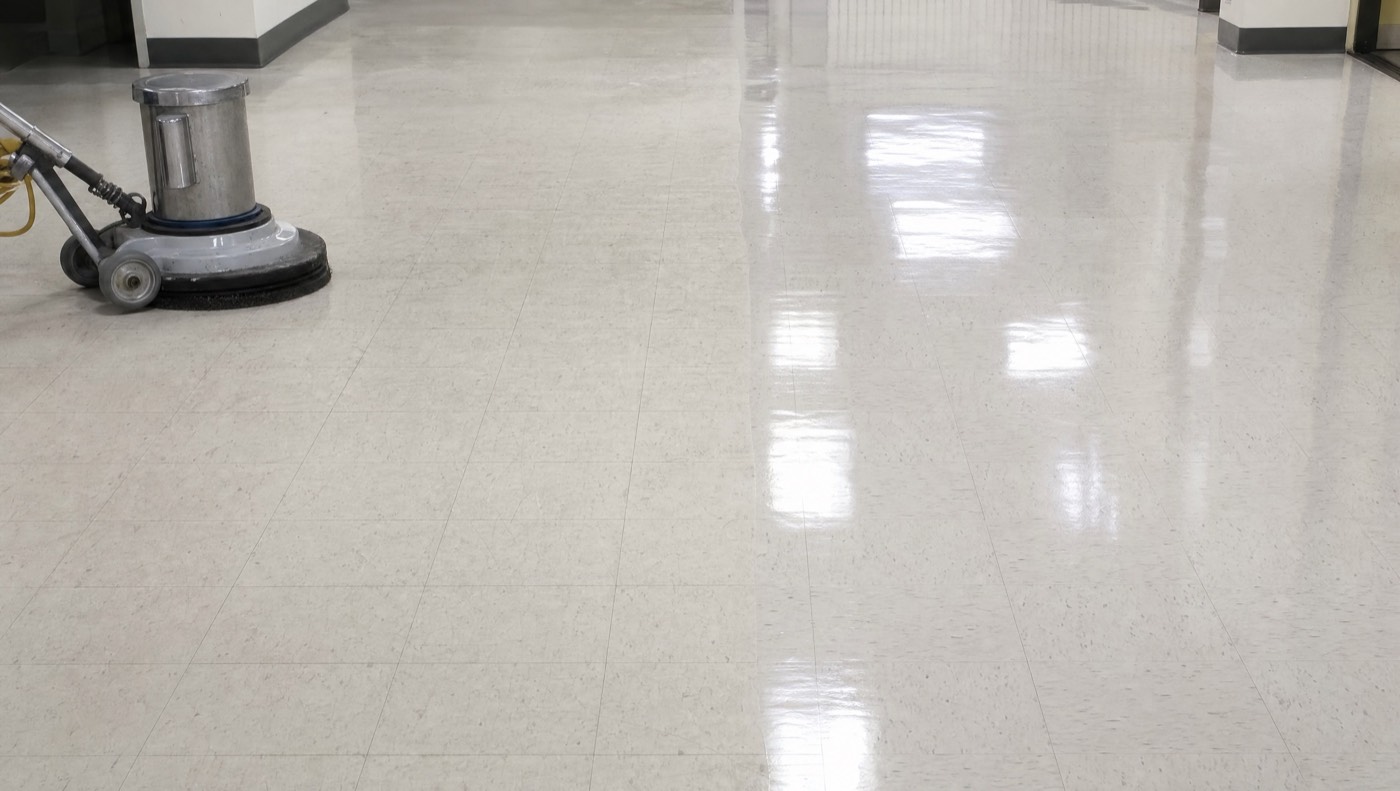
VCT is probably the most common hard floor in American schools, stores, and clinics, and the one most often confused with the luxury vinyl that looks nothing like it underneath. If you are deciding how to care for a floor, the first question is whether it is VCT, because that changes everything.
Vinyl Composition Tile is a blend of vinyl resin, limestone (mineral) filler, pigments, and stabilizers, pressed into rigid tiles. The high filler content is what makes it inexpensive and durable, and also what makes it porous, the surface is not a sealed wear layer, so it relies on coats of floor finish for protection and shine. The color and pattern run through the tile, so light wear does not expose a different layer underneath.
| VCT | LVT / LVP | Sheet vinyl | |
|---|---|---|---|
| Form | Rigid 12-inch tiles | Tiles or planks with a wear layer | Continuous rolled sheet |
| Surface | Porous, needs finish | No-wax wear layer | Wear layer, often no-wax |
| Care | Strip and wax, recoat, burnish | Clean and protect, no wax | Clean and protect |
| Look | Solid, speckled colors | Realistic wood and stone | Printed patterns |
Mixing these up is the most common floor-care mistake. More on luxury vinyl: LVT vs. LVP.
Bare VCT stains, scuffs, and wears quickly because the tile itself is porous. Coats of floor finish seal the surface, give it gloss, and take the traffic so the tile does not. That is why a VCT floor lives on a cycle of strip and wax, scrub-and-recoat, and burnishing, and why a neglected VCT floor looks bad fast.
The common thread is a lot of square footage on a budget, with appearance maintained through finish rather than the floor itself.
| Pros | Cons |
|---|---|
| Low material cost | Requires regular finish maintenance |
| Durable; through-color hides wear | Porous; stains if left unfinished |
| Individual tiles replaceable | Labor over its life adds up without a program |
| High-gloss look when maintained | Less realistic look than LVT |
The takeaway: VCT is cheapest to buy and cheapest over its life only when it is maintained on a schedule. See how we care for it on the VCT floor care page.
Related: VCT floor care (service), LVT vs. LVP, sealing vs. waxing, and how many coats.
Have a VCT floor that needs work? See VCT floor care or get a free assessment.
Vinyl Composition Tile, a hard floor made of vinyl resin and mineral filler, commonly in 12-by-12-inch tiles.
No. VCT is porous and needs floor finish (wax); LVT and LVP have a no-wax factory wear layer and are cleaned and protected, not waxed.
Practically, yes. VCT is porous, so it relies on coats of floor finish for protection and shine. Bare VCT stains and wears quickly.
With proper finish maintenance, VCT can last for decades, and individual damaged tiles can be replaced rather than redoing the floor.
Most commonly 12 by 12 inches, with other sizes available. The tiles are rigid and relatively thin.
Yes. The through-color and filler content make it tough and forgiving of wear, which is why it is so common in high-traffic commercial space, as long as the finish is kept up.
Yes, especially where large areas need an economical, durable, easily refinished floor, though luxury vinyl has taken some of its former uses.
On a cycle of strip and wax, scrub-and-recoat, and burnishing, ideally on a maintenance program. See our VCT floor care page.
This guide should support both education and conversion: define the issue clearly, explain when the topic affects strip-and-wax, scrub-and-recoat, VCT care, burnishing, polishing, sealing, or maintenance programs, and point the reader to quote, cost, facility, and provider pages where the next step belongs.
Facility type, floor material, square footage, current condition, service needed, timing, access window, photos, traffic areas, safety concerns, and decision-maker contact details.
Photos are optional but helpful. A remote video walkthrough is a convenience option when condition or access is hard to explain. Larger schools, hospitals, universities, municipalities, portfolios, and complex projects may still need an in-person walkthrough.
Strip&Wax.com builds coverage carefully by collecting real facility requirements, provider service areas, capability details, and quote outcomes. The site focuses on accurate scope, clear expectations, and useful commercial floor-care guidance before an opportunity is routed.
Use these related pages to compare services, understand cost, plan facility-specific work, and route the right commercial floor-care opportunity.
A strong request gives a commercial floor-care team enough context to understand the building, the surface, the deadline, and the condition of the floor without making the form hard to finish.
Commercial floor-care buyers are usually trying to protect a facility, prepare for traffic, improve presentation, control safety risk, or restore floors before a deadline. The best quote requests connect the floor problem to the service, floor type, facility type, schedule, and access requirements.
High-value requests often include thousands of square feet, multiple rooms, heavy traffic lanes, old finish buildup, school or healthcare scheduling windows, retail entrances, warehouse walkways, municipal procurement steps, or a multi-location maintenance need. The buyer should understand that price changes with condition and access, not just square footage.
Useful quote notes include the facility type, floor material, current condition, deadline, preferred service window, whether furniture or shelving must move, whether the building needs low-odor products, and whether photos or a remote walkthrough can show the problem better than a written description.
Use the links below to compare scrub vs strip, review VCT floor care, check industry examples, estimate pricing with the cost calculator, or request a quote.
Use these resources to narrow the request into the right service, surface, and facility type: commercial floor waxing, floor stripping and waxing, VCT maintenance, scrub-and-recoat, burnishing, school floor care, healthcare floor care, retail floor care, and industrial floor maintenance. The buyer does not need every technical term before submitting the request.
Use this page to move from a general floor-care question into the right quote path. Commercial floor work gets easier to price when the buyer identifies the facility type, floor material, condition, timing, and project goal.
What Is VCT? Vinyl Composition Tile, Explained supports the buyer before they request pricing. A useful floor-care guide should help a facility manager understand what to look for, what to photograph, what questions to ask, and which service page to use next. It should also connect the reader to quote-ready pages instead of leaving them at a dead end after reading the article.
The commercial value is in converting research intent into a quote request. When the reader knows whether they need stripping and waxing, scrub-and-recoat, burnishing, floor maintenance, VCT care, tile-and-grout work, or another service, the next click should be obvious and close by.
Do not wait until every detail is perfect. Start the quote request with the basics, then add photos, measurements, floor type, or walkthrough notes when available. Larger schools, hospitals, municipal buildings, retail stores, warehouses, and multi-location properties can add scope details during follow-up.
Request a floor-care quoteTell us your facility, floor types, and square footage. We'll scope the work and send a written quote. Not sure what you have? Send a photo and we'll tell you.