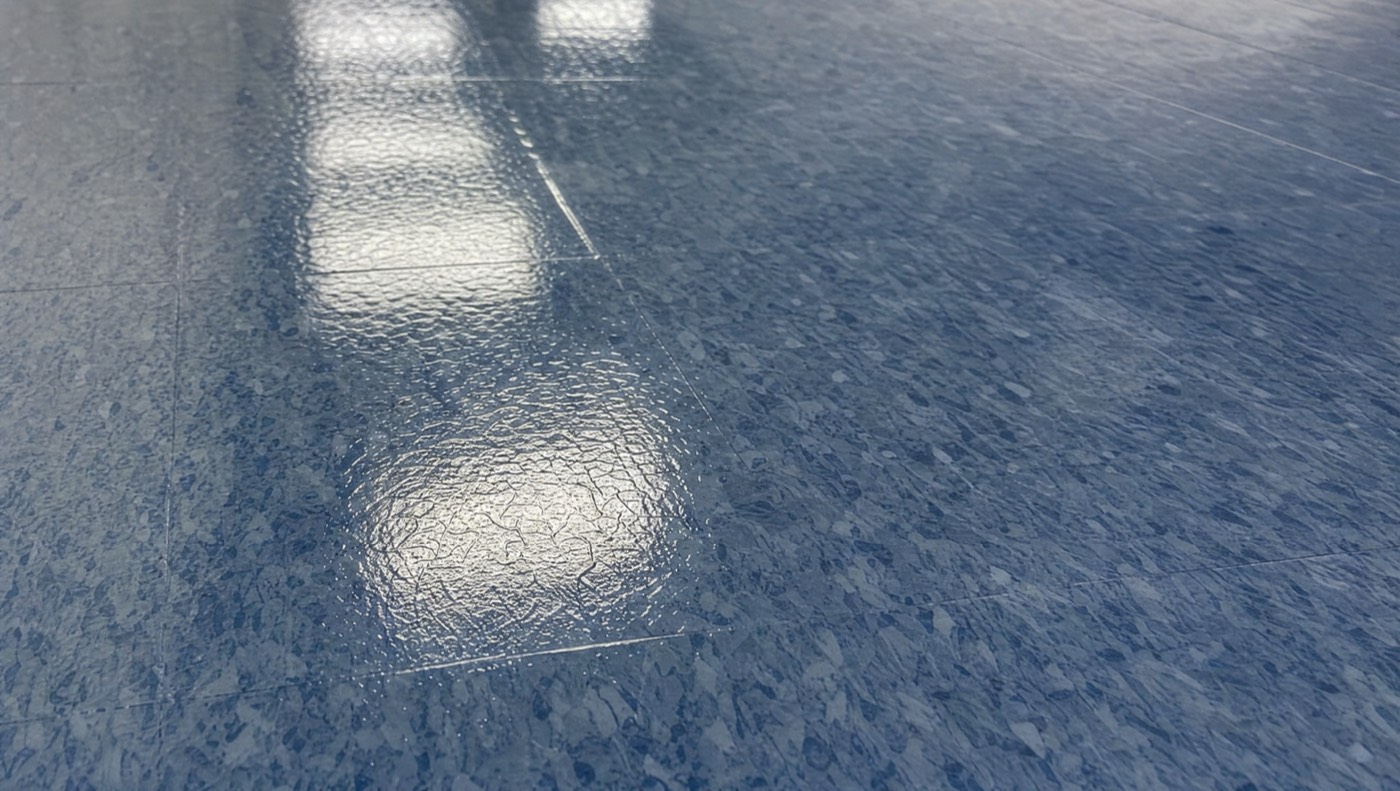
Almost every floor-finish problem traces back to one of two things: a shortcut during stripping and prep, or a gap in maintenance. The good news is that the symptoms are readable. Here is what each one means and how it gets fixed.
| Problem | Likely cause | Fix |
|---|---|---|
| Yellowing | Old finish not fully stripped, or applied over residue | Full strip, neutralize, rinse, rebuild |
| Hazing / clouding | Finish over dirty or un-neutralized floor; too many coats too fast | Strip and rebuild correctly |
| Powdering / dusting | Burnishing finish that was not cured, or over residue | Let finish cure; correct the build, then burnish |
| Peeling / poor adhesion | Skipped neutralize-and-rinse; bonded poorly | Strip, neutralize, rinse, refinish |
| Tacky / will not dry | Too thick, humid or cold, or poor ventilation | Improve airflow and dry time; thinner coats |
| Black scuff marks | Soft or under-burnished finish | Burnish; use a harder finish |
| Swirl / burn marks | Wrong pad, speed too high, dwelling too long | Correct pad and technique |
| Streaks / roller marks | Thick, uneven coats | Thin, even coats; strip if severe |
| Slippery when wet | Wet floor, or wrong product for the setting | Address moisture; matched finish and matting |
Yellowing is the complaint we hear most, and it almost always means old finish was not fully removed, or new finish went over residue or an un-neutralized floor. The color sits in the lower layers, so a recoat will not touch it. The only real fix is a full strip and wax that removes everything, neutralizes, rinses, and rebuilds clean. Done right, the floor comes back clear. The way to prevent it is to never skip the neutralize-and-rinse step, see stripper types.
These three are prep and timing failures. Powdering (a chalky dust) comes from burnishing finish that had not cured, or finish over residue. Hazing comes from coating a floor that was dirty or not neutralized, or piling on coats too fast. Peeling is an adhesion failure, almost always a skipped neutralize-and-rinse so the finish never bonded. All three are corrected by stripping back and rebuilding properly: clean, neutralize, rinse, seal, then thin even coats with cure time between them.
Two habits prevent most of this. First, never shortcut the strip, the neutralize-and-rinse is the step that prevents yellowing, hazing, and peeling. Second, maintain on a schedule, burnishing cured finish and recoating before it fails. A maintenance program builds both in, which is why programmed floors rarely show these problems.
Related: strip and wax, floor stripper types, how many coats, and buffing and burnishing.
Got a finish problem you want gone for good? Get a free assessment.
Old finish was not fully stripped, or new finish was applied over residue or an un-neutralized floor. The fix is a full strip, neutralize, rinse, and rebuild.
Usually the finish was burnished before it cured, or it was applied over residue. Let finish cure fully and correct the build before burnishing.
An adhesion failure, almost always from skipping the neutralize-and-rinse after stripping, so the finish never bonded. Strip, neutralize, rinse, and refinish.
Coats too thick, or cold, humid, or poorly ventilated conditions. Improve airflow, allow more dry time, and apply thinner coats.
Finish applied over a dirty or un-neutralized floor, or too many coats too fast. It needs to be stripped and rebuilt correctly.
Buffing or burnishing lifts most heel marks; recurring scuffs point to a soft or under-burnished finish that should be burnished more or made harder.
A correct, cured, burnished finish is built for traction. Slipperiness usually means the floor is wet or the wrong product was used.
Never skip the neutralize-and-rinse during stripping, apply thin even coats with cure time, and maintain on a schedule of burnishing and recoats.
This guide should support both education and conversion: define the issue clearly, explain when the topic affects strip-and-wax, scrub-and-recoat, VCT care, burnishing, polishing, sealing, or maintenance programs, and point the reader to quote, cost, facility, and provider pages where the next step belongs.
Facility type, floor material, square footage, current condition, service needed, timing, access window, photos, traffic areas, safety concerns, and decision-maker contact details.
Photos are optional but helpful. A remote video walkthrough is a convenience option when condition or access is hard to explain. Larger schools, hospitals, universities, municipalities, portfolios, and complex projects may still need an in-person walkthrough.
Strip&Wax.com builds coverage carefully by collecting real facility requirements, provider service areas, capability details, and quote outcomes. The site focuses on accurate scope, clear expectations, and useful commercial floor-care guidance before an opportunity is routed.
Use these related pages to compare services, understand cost, plan facility-specific work, and route the right commercial floor-care opportunity.
Commercial floor-care buyers are usually trying to protect a facility, prepare for traffic, improve presentation, control safety risk, or restore floors before a deadline. The best quote requests connect the floor problem to the service, floor type, facility type, schedule, and access requirements.
High-value requests often include thousands of square feet, multiple rooms, heavy traffic lanes, old finish buildup, school or healthcare scheduling windows, retail entrances, warehouse walkways, municipal procurement steps, or a multi-location maintenance need. The buyer should understand that price changes with condition and access, not just square footage.
Useful quote notes include the facility type, floor material, current condition, deadline, preferred service window, whether furniture or shelving must move, whether the building needs low-odor products, and whether photos or a remote walkthrough can show the problem better than a written description.
Use the links below to compare scrub vs strip, review VCT floor care, check industry examples, estimate pricing with the cost calculator, or request a quote.
Use these resources to narrow the request into the right service, surface, and facility type: commercial floor waxing, floor stripping and waxing, VCT maintenance, scrub-and-recoat, burnishing, school floor care, healthcare floor care, retail floor care, and industrial floor maintenance. The buyer does not need every technical term before submitting the request.
Use this page to move from a general floor-care question into the right quote path. Commercial floor work gets easier to price when the buyer identifies the facility type, floor material, condition, timing, and project goal.
Floor Finish Problems: Yellowing, Hazing, Powdering, and How to Fix Them supports the buyer before they request pricing. A useful floor-care guide should help a facility manager understand what to look for, what to photograph, what questions to ask, and which service page to use next. It should also connect the reader to quote-ready pages instead of leaving them at a dead end after reading the article.
The commercial value is in converting research intent into a quote request. When the reader knows whether they need stripping and waxing, scrub-and-recoat, burnishing, floor maintenance, VCT care, tile-and-grout work, or another service, the next click should be obvious and close by.
Do not wait until every detail is perfect. Start the quote request with the basics, then add photos, measurements, floor type, or walkthrough notes when available. Larger schools, hospitals, municipal buildings, retail stores, warehouses, and multi-location properties can add scope details during follow-up.
Request a floor-care quoteTell us your facility, floor types, and square footage. We'll scope the work and send a written quote. Not sure what you have? Send a photo and we'll tell you.