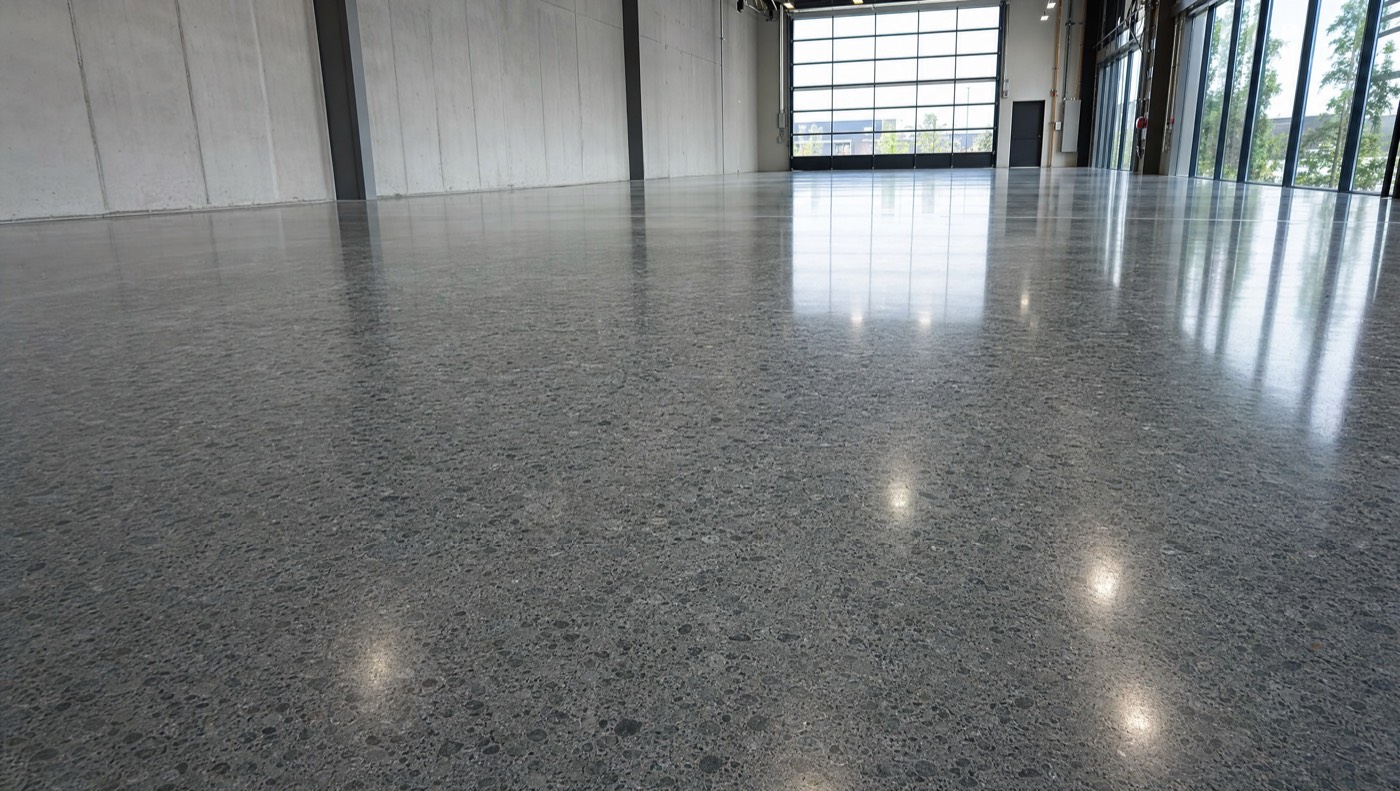
Polished concrete is the glossy gray floor you have walked across in a hundred stores and warehouses, and it is not paint, epoxy, or wax. It is the concrete itself, ground and polished until it shines. Here is what that actually means, and how it differs from the coated and sealed floors people confuse it with.
Polished concrete is a mechanical process, not a coating. The slab is ground with progressively finer diamond abrasives, and a chemical densifier hardens the surface, until the concrete itself takes on a smooth, reflective shine. Nothing is applied on top to create the gloss, the shine is the polished stone and cement of the slab. That is the key difference from epoxy, paint, or wax, which sit on the surface and wear off.
| Type | What it is |
|---|---|
| Polished | Mechanically ground and densified; the slab shines on its own |
| Sealed | A penetrating or film sealer applied for stain and moisture protection |
| Coated | Epoxy or urethane bonded on top of the slab |
| Stained / dyed | Color added to the concrete, often then polished or sealed |
These get used loosely, but they are different floors with different maintenance. How we service each is on the concrete floor care page.
| Finish | Roughly | Look |
|---|---|---|
| Matte / satin | ground and densified, lower grit | Low sheen, soft reflection |
| Semi-polished | around 800 grit | Moderate sheen |
| Polished | around 1500 grit | High, clear gloss |
| High-polished | around 3000 grit | Mirror-like gloss |
How much the slab is ground also sets how much of the stone aggregate shows, which is an appearance choice:
| Exposure | Look |
|---|---|
| Cream / no exposure | Smooth cement surface, no stone showing |
| Salt and pepper | Light grind reveals fine aggregate flecks |
| Full aggregate | Deeper grind exposes the stone like terrazzo |
| Pros | Cons |
|---|---|
| Very durable; no coating to peel | Hard underfoot |
| Low maintenance, no wax or recoating | Shows cracks and slab imperfections |
| Bright; can reduce lighting needs | Initial polishing is labor-intensive |
| Long service life on a sound slab | Best results need a suitable slab |
Maintained well, it is one of the lowest-upkeep commercial floors there is.
Related: concrete floor care (service), dust control and silica, stone polishing, and sealing vs. waxing.
Have a concrete floor to polish or maintain? See concrete floor care or get a free assessment.
Concrete that has been mechanically ground and densified, then polished with progressively finer diamonds until the slab itself shines, with no coating or wax.
No. Polishing is a mechanical shine in the slab itself; sealing applies a protective sealer; epoxy is a coating bonded on top. They look similar but are different floors.
From a soft satin to a near-mirror high gloss, depending on how far the diamond polishing is taken, roughly up to a 3000-grit level.
It resists stains far better than bare concrete, especially with a densifier and guard, but oils and acids should still be cleaned up promptly.
On a sound slab and maintained, it can last many years with only occasional re-polishing, since there is no coating to wear off.
When clean and dry it offers reasonable traction; like any hard floor it is slippery when wet, so spills should be addressed promptly.
Usually yes, if the slab is sound. Grinding and densifying an existing slab is common and often beats installing a new floor.
Polishing with a densifier and guard is often enough, though a penetrating sealer or guard adds stain resistance in demanding spaces.
This guide should support both education and conversion: define the issue clearly, explain when the topic affects strip-and-wax, scrub-and-recoat, VCT care, burnishing, polishing, sealing, or maintenance programs, and point the reader to quote, cost, facility, and provider pages where the next step belongs.
Facility type, floor material, square footage, current condition, service needed, timing, access window, photos, traffic areas, safety concerns, and decision-maker contact details.
Photos are optional but helpful. A remote video walkthrough is a convenience option when condition or access is hard to explain. Larger schools, hospitals, universities, municipalities, portfolios, and complex projects may still need an in-person walkthrough.
Strip&Wax.com builds coverage carefully by collecting real facility requirements, provider service areas, capability details, and quote outcomes. The site focuses on accurate scope, clear expectations, and useful commercial floor-care guidance before an opportunity is routed.
Use these related pages to compare services, understand cost, plan facility-specific work, and route the right commercial floor-care opportunity.
A strong request gives a commercial floor-care team enough context to understand the building, the surface, the deadline, and the condition of the floor without making the form hard to finish.
Commercial floor-care buyers are usually trying to protect a facility, prepare for traffic, improve presentation, control safety risk, or restore floors before a deadline. The best quote requests connect the floor problem to the service, floor type, facility type, schedule, and access requirements.
High-value requests often include thousands of square feet, multiple rooms, heavy traffic lanes, old finish buildup, school or healthcare scheduling windows, retail entrances, warehouse walkways, municipal procurement steps, or a multi-location maintenance need. The buyer should understand that price changes with condition and access, not just square footage.
Useful quote notes include the facility type, floor material, current condition, deadline, preferred service window, whether furniture or shelving must move, whether the building needs low-odor products, and whether photos or a remote walkthrough can show the problem better than a written description.
Use the links below to compare scrub vs strip, review VCT floor care, check industry examples, estimate pricing with the cost calculator, or request a quote.
Use these resources to narrow the request into the right service, surface, and facility type: commercial floor waxing, floor stripping and waxing, VCT maintenance, scrub-and-recoat, burnishing, school floor care, healthcare floor care, retail floor care, and industrial floor maintenance. The buyer does not need every technical term before submitting the request.
Use this page to move from a general floor-care question into the right quote path. Commercial floor work gets easier to price when the buyer identifies the facility type, floor material, condition, timing, and project goal.
What Is Polished Concrete? A Plain-English Guide supports the buyer before they request pricing. A useful floor-care guide should help a facility manager understand what to look for, what to photograph, what questions to ask, and which service page to use next. It should also connect the reader to quote-ready pages instead of leaving them at a dead end after reading the article.
The commercial value is in converting research intent into a quote request. When the reader knows whether they need stripping and waxing, scrub-and-recoat, burnishing, floor maintenance, VCT care, tile-and-grout work, or another service, the next click should be obvious and close by.
Do not wait until every detail is perfect. Start the quote request with the basics, then add photos, measurements, floor type, or walkthrough notes when available. Larger schools, hospitals, municipal buildings, retail stores, warehouses, and multi-location properties can add scope details during follow-up.
Request a floor-care quoteTell us your facility, floor types, and square footage. We'll scope the work and send a written quote. Not sure what you have? Send a photo and we'll tell you.